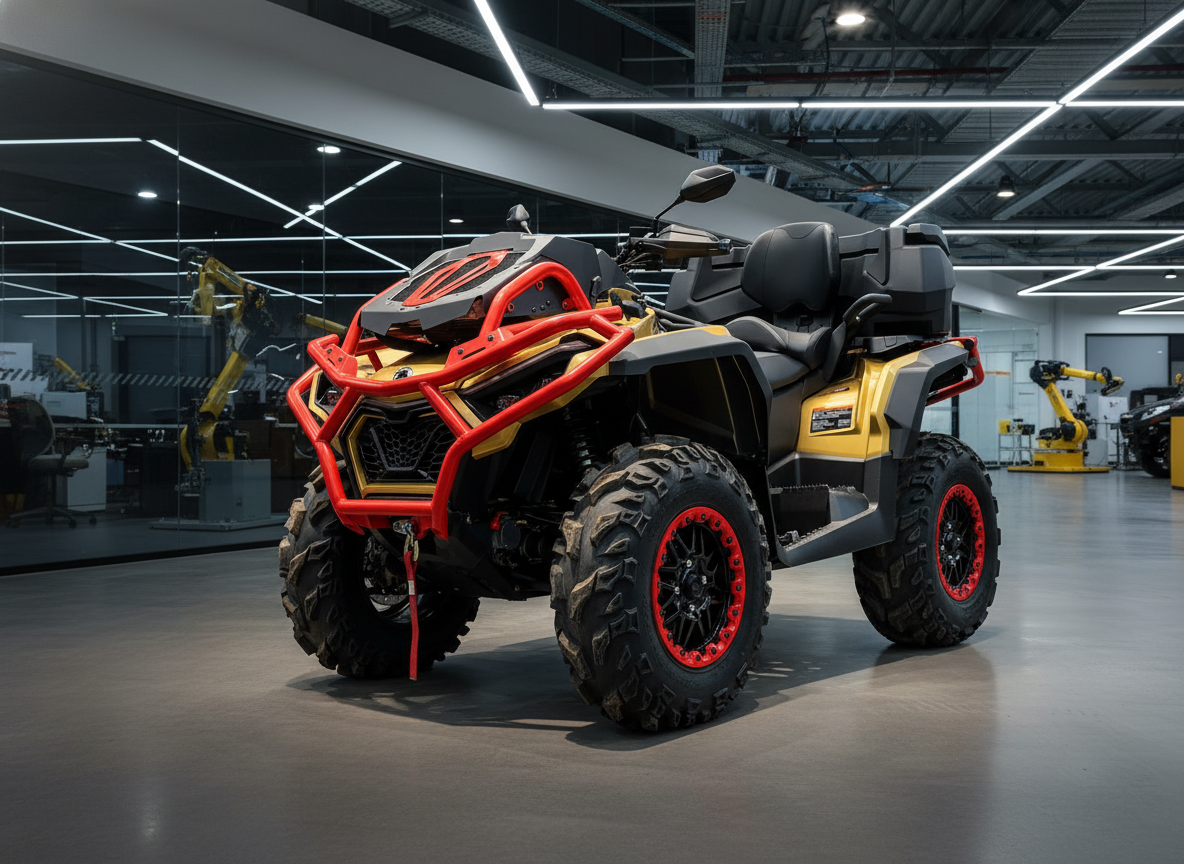
The "Made in China" Misconception
Just a few years ago, "Chinese ATV" often meant cheap equipment that would barely last a season. Today, that assumption increasingly misses the mark. The market has matured, manufacturers have professionalized, and riders have started evaluating machines based on how they perform and how they're serviced—not where the factory happens to be located.
The reality is straightforward: a Chinese ATV isn't inherently inferior. Just as Europe and the USA produce both excellent and mediocre models, China offers the full spectrum of quality. "Made in China" no longer describes quality—it describes geography.
"Chinese" Doesn't Mean "Low Quality"—It's About Product Class
China is now the world's largest manufacturing hub. The country produces everything from budget "no-name" equipment to technologically advanced components for global brands. Durability isn't determined by country of origin, but by:
- Design and materials used in construction
- Quality control processes during manufacturing
- Production standards and equipment
- Service culture of the importer and dealer network
Comparing the cheapest Chinese ATV to a top-tier American machine is inherently unfair. The honest comparison is segment to segment: budget to budget, mid-range to mid-range.
Same Supply Chains, Same Technologies
In ATVs, specific components matter: fuel injection, electronics, suspension, brakes, bearings, seals, castings, welds, wiring harnesses, and plastics. Today, many Chinese manufacturers:
- Source components from recognized global suppliers
- Operate CNC machines and automated welding lines
- Implement quality procedures (leak testing, drivetrain durability testing, frame stress testing)
This isn't garage production anymore—in many cases, it's industrial manufacturing comparable to anywhere in the world.
The Biggest Leap: Build Quality and Consistency
In the past, the biggest problem with budget Chinese machines was consistency: one unit ran perfectly, another needed immediate fixes. Today, in the mid-range and premium segments, you increasingly find:
- Stable geometry and better panel fitment
- Properly routed electrical harnesses
- Improved corrosion protection
- Stronger suspension and drivetrain components
Consistency is the hallmark of a mature manufacturer—and this is where real progress has been made.
Price Reflects Business Model, Not Just Corners Cut
Many assume "cheaper = worse." But often, lower prices result from:
- Lower labor costs and production scale
- Shorter supply chains with fewer margin layers
- Reduced global marketing expenses
- No "brand premium" markup
In the budget segment, cost savings can be painful. But in the mid-range, price differences often stem from economics rather than quality compromises.
"American and European" Doesn't Always Mean "Trouble-Free"
This uncomfortable truth applies to all premium brand enthusiasts: every manufacturer—regardless of country—experiences:
- Problematic model years or designs
- Factory defect series
- Components that wear faster in demanding conditions
- Electronics issues (especially in modern models)
The difference often comes down to established brands having more developed service networks and readily available parts. And this leads to the most important consideration.
The Importer Makes or Breaks the Experience
Even the best ATV loses its appeal if:
- Parts take 3-4 weeks to arrive
- There are no catalogs or part numbers
- The service center "learns" on your machine
- The warranty exists only on paper
For Chinese ATVs, the critical questions are:
- Is there an official service network and real warranty?
- Does the importer maintain parts inventory in the country/EU?
- Are service manuals, diagrams, and diagnostics available?
- Does the model have homologation (for legal road use)?
When the answer is "yes," quality differences in daily use can shrink dramatically.
When Does a Chinese ATV Make Sense?
A Chinese ATV often wins when you:
- Want maximum features for the price (winch, LED lighting, digital display, EPS, guards)
- Need equipment for recreation, property work, or reasonable mud adventures
- Prefer simpler, less complicated solutions (easier repairs)
- Want to enter the hobby without spending car-level money
For extreme, daily punishment in the harshest conditions, top brands still have the advantage of experience and proven platforms. But that doesn't mean "Chinese can't handle it"—it means matching the equipment to the application.
What to Look for When Buying
Instead of asking "is Chinese good?", check:
- Manufacturer and segment: Budget, mid-range, or premium?
- Service and parts access: Delivery times, prices, local inventory
- Long-term reviews: After 1-2 seasons, not just the first week
- Frame and protection: Corrosion resistance, guards, weld quality
- Drivetrain and cooling: Temperature management in mud, CVT solutions
- Electrical system: Connectors, harnesses, sealing, module placement
The Bottom Line
Chinese ATVs aren't inherently inferior. They're simply different: often better equipped at their price point, increasingly well-built, with real quality depending on the model class and how the importer/service network operates. Today, "Chinese ATV" isn't a verdict—it's a category where you can find both weak equipment and genuinely strong, sensible choices.

